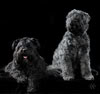
Marjoleine schreef:Madelief schreef:Zwart, Fauve (sable in al zijn varianten), Zwartgeboren grijs en Blauw (Grijs geboren grijs), en Ardoise (zwart met witte haren).
Wat is zwart geboren grijs genetisch?
Ik heb er nog nooit van gehoord.
De rest is duidelijk.
6. THE G BASIC GENE (G locus) influences the GRAYING of black coat color from birth to maturity or throughout life.
G is a partial dominant and a puppy with this gene form is born black will clear more and more to gray as it grows older. Type: Kerry Blue and Bedlington Terriers and in
Poodles. (This is NOT the gene series that produces the “Noire Ardoise”, a black with some white hairs throughout the coat.)
g The coat color remains constant, without graying.
The G basic gene in the Briard
There are Briards born black, which turn increasingly gray in color with age. This is probably produced by the G/graying gene. This is based on observation since no scientific studies (out crossing to other breeds) have been done.
The gray born black is considered a true gray, and is not a dilution as is produced by
the dd/dilution or the M/merle genes.
Marjoleine schreef:Madelief schreef:Je kunt in Wageningen honden testen op "lemon, brown and yellow" Heeft mijn moeder vandaag gehoord via de RvB in een buitengewoon vaag verhaal, maar een bevriende fokker uit Duitsland heeft een link gestuurd waar ze in Duitsland in één week hetero/homozygotie kunnen bepalen.
lemon als in recessief geel e/e?
brown as in b neem ik aan.
yellow als in sable (fauve)?
Dat is mij eerlijk gezegd niet duidelijk, maar naar ik begrepen heb was het al vreselijk moeilijk om de dame aan de telefoon dit te laten zeggen. Die wist eigenlijk niet goed waar het over ging. Maar dat is ook mijn gedachte erachter...e, b en a
Het document hierboven doet één en ander erg duidelijk uit de boeken. De link werkt nu



 te klein dus !!

 )
) !
!







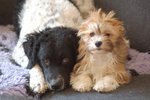
 Tenslotte leest het als bijvoeglijk naamwoord(en) en dus lees ik bij jouw versie dat de pup grijs geboren is en zwart werd, haha.